Introduction
If you have ever seen terms like PST or PDT and felt confused, you are not alone.
In India, we follow IST, which stands for Indian Standard Time. But when you deal with international clients, remote jobs, or global companies, you will often come across PST and PDT.
The easiest way to understand them is by comparing everything with IST.
Understanding the Full Forms First
Let’s make this very simple:
IST means Indian Standard Time
PST means Pacific Standard Time
PDT means Pacific Daylight Time
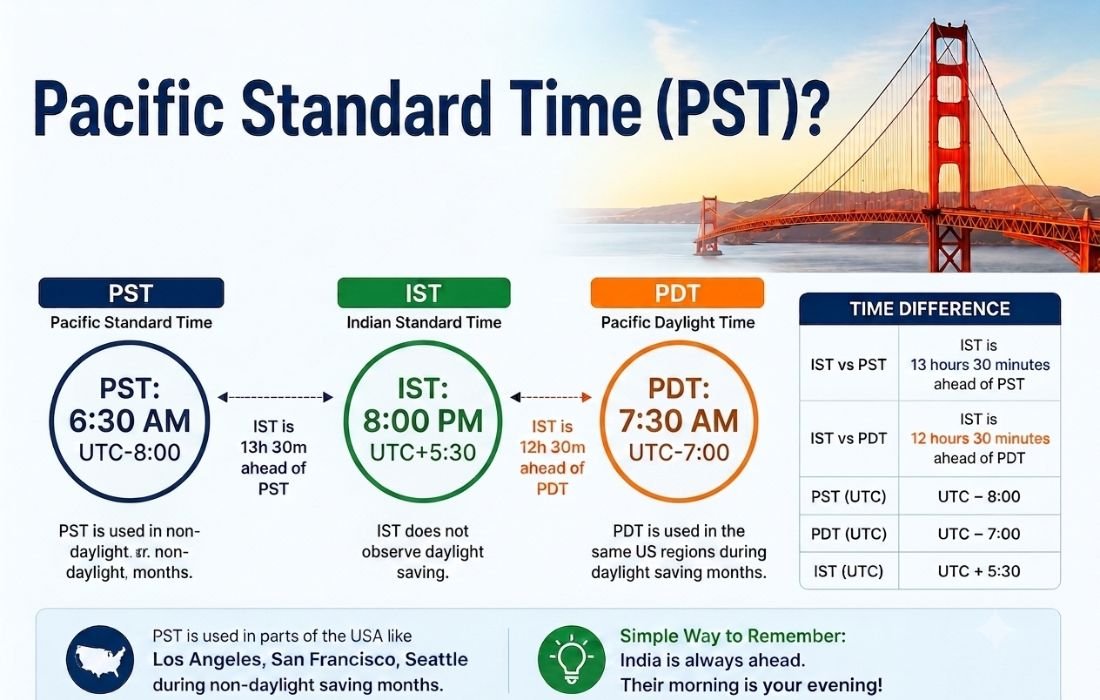
IST is used in India. PST and PDT are used in parts of the United States like Los Angeles and San Francisco.
IST vs PST Time Difference
Now the most important part.
IST is 13 hours and 30 minutes ahead of PST
This means:
If it is 8 00 PM in IST, it is 6 30 AM in PST
If it is 9 00 AM in IST, it is 7 30 PM in PST on the previous day
So PST is almost half a day behind India.
This is why meetings with US teams often happen at night for people in India.
IST vs PDT Time Difference
There is one small change during part of the year.
The United States follows daylight saving time, where they shift their clocks forward by one hour.
During this period, PST becomes PDT.
IST is 12 hours and 30 minutes ahead of PDT
This means:
If it is 8 00 PM in IST, it is 7 30 AM in PDT
If it is 9 00 AM in IST, it is 8 30 PM in PDT on the previous day
So the gap becomes slightly smaller during these months.
Why PST and PDT Both Exist
You might wonder why there are two names.
PST is used during the normal part of the year
PDT is used when daylight saving time is active
So it is the same region, just different clock settings depending on the season.
Why This Matters for Us in India
Today, many students and professionals in India work with global teams.
If you are doing internships, freelancing, marketing work, or finance projects, there is a high chance you will deal with US based timings.
For example:
If a meeting is scheduled at 10 00 AM PST, you need to know it will be late evening in India
If it is 10 00 AM PDT, it will be slightly earlier, but still in the evening
Knowing the difference helps you avoid missing meetings or getting confused.
Simple Way to Remember
Here is the easiest trick:
India is always ahead
The US west coast is always behind
And the difference is around half a day
So:
Their morning is your evening
Their night is your morning
That is enough to quickly estimate most timings.
Conclusion
Pacific Standard Time and Pacific Daylight Time may sound complicated at first, but they become very easy once you compare them with Indian Standard Time
The key thing to remember is:
IST is 13 hours and 30 minutes ahead of PST
IST is 12 hours and 30 minutes ahead of PDT
In today’s global world, understanding this is not just useful, it is necessary.
Whether you are a student, freelancer, or working professional, this simple knowledge will help you manage international schedules with confidence.
Also Read : What Is Real-Time Marketing For E-commerce?